Mood trackers have quietly become one of the most crowded corners of the App Store. Some are two-tap diaries. Some are AI chatbots. Some are clinical questionnaires wearing a friendly interface. They all promise the same thing — that if you log how you feel for long enough, you’ll finally understand yourself a little better.
The catch is that most of them stop at logging. You end up with a wall of emoji and a chart that goes up and down, but no honest answer to the only question that matters: am I actually doing okay, running low, or getting better?
In 2026 the best apps are the ones that close that gap — that pair what you say about your day with what your body did overnight, and put both on the same scale. Below we compare ten mood tracker apps for iPhone, what each is genuinely good at, where each falls short, and roughly what they cost. We start with our own app, Well, and then walk through nine strong alternatives so you can pick the one that fits how you think.
How we compared them
Every app here can log a mood. So we judged them on the things that actually change how useful a tracker is over months of real use:
- Speed of logging — how much friction there is between opening the app and being done.
- Passive health data — whether it reads sleep, HRV, resting heart rate and steps from Apple Health / wearables, or leaves you to type everything by hand.
- Correlations & factors — whether it can tell you what tends to affect you, not just how you felt.
- Insight quality — plain-language understanding versus a raw dashboard.
- AI and privacy — whether there’s any AI, and if so, whether your data leaves your phone.
- Platforms & price — where it runs and what it costs in 2026.
Prices below are approximate 2026 figures and vary by region and store promotions — always check the current App Store listing before subscribing.
1. Well — the whole picture, measured against you
Best for: people who want one honest number instead of ten disconnected charts.
Price: free to download · Platforms: iPhone (iOS 26+)
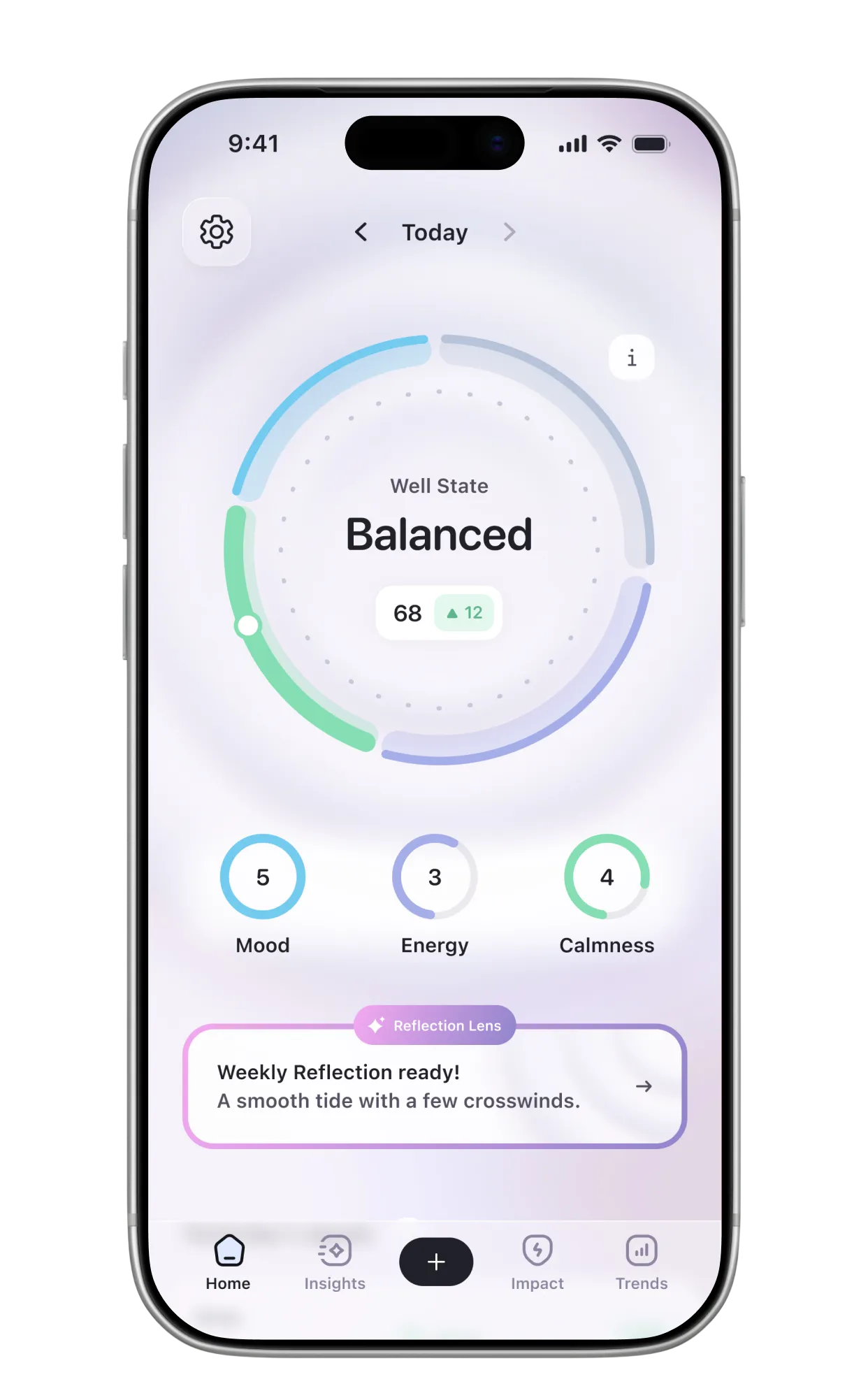
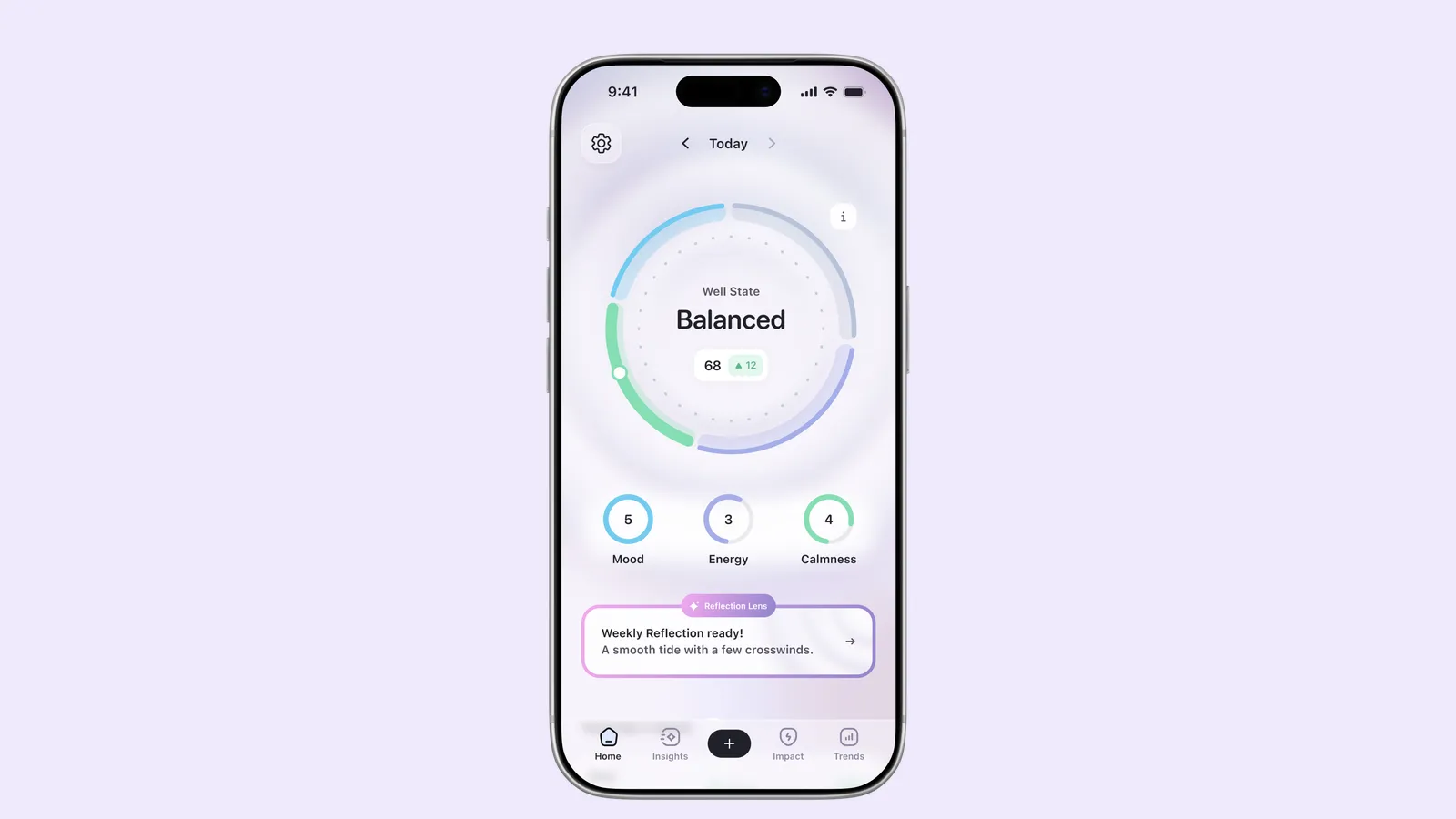
Most apps ask how you feel. A few read your body. Well does both — and, crucially, calibrates one against the other. Each morning it recalculates a single Well State from your mood, energy and calmness check-ins, then adjusts it with what your body reported overnight: sleep, heart rate variability, resting heart rate and steps pulled quietly from Apple Health. Zones run from Low through Recovering and Balanced to Peak.
What sets Well apart is that every signal is compared to your own rolling baseline, never to a generic population target. Someone whose natural resting heart rate is 80 bpm is measured against their own norm, not a fitness chart. And because the score leans on your history rather than a single day, one rough night doesn’t crater it and one good one doesn’t rescue it.
The daily habit is tiny — three sliders and a few taps to tag what shaped your day, plus an optional journal note — but the payoff compounds:
- Impact shows how each factor you track (coffee, meetings, workouts, alcohol, or anything you invent) relates to your mood, energy, calmness or overall state, as a percentage built entirely from your own check-ins.
- Reflection Lens reads your week — check-ins, passive signals and journal notes together — and writes back a short, plain-language reflection with one gentle piece of guidance. It runs on Apple’s on-device model, so your week is analysed on your iPhone and never leaves it.
- Trends & history keep every day rather than averaging it away, so the slow drifts a daily view hides become obvious over weeks and months.
Well is deliberately private: on-device AI, Apple Health access only with your permission and revocable anytime, no ads, and no data sold. It’s a wellness app, not a medical device — it won’t diagnose you and won’t pretend to. If you want the fastest path from tracking to actually understanding, this is the one to beat.
2. Daylio — the fastest logger
Best for: people who won’t stick with anything that takes more than two taps.
Price: free; Premium ~$4.99/mo or ~$35.99/yr · Platforms: iOS, Android
Daylio is the reigning champion of low-friction logging. Pick a mood on a five-point scale, tap a few activity icons, and you’re done — no writing required. Over time it produces tidy statistics, a mood calendar, a “Year in Pixels” view, and correlations between your activities and how you felt. It even syncs steps, sleep and exercise time from Apple Health to line them up against mood.
Its strength is consistency: because logging is so frictionless, people actually keep it up, and the activity-to-mood correlations get genuinely useful. The limitation is depth — there’s no AI, no plain-language insight, and the biometric side is shallow compared with apps built around wearable data. Daylio tells you that something correlates; it won’t interpret it for you or fold HRV and resting heart rate into a single score.
3. Bearable — the data powerhouse
Best for: people tracking symptoms or chronic conditions alongside mood.
Price: free; Premium ~$6.99/mo or ~$34.99/yr · Platforms: iOS, Android
If you want to correlate everything, Bearable is the most capable tracker here. It logs mood, energy, physical and emotional symptoms, medications, sleep and any custom factor you like — and it pulls a rich stream of passive data from Apple Health, Google Fit and Fitbit, including heart rate, sleep, steps and more. Its correlations-and-insights engine is the core of the app, and it’s a favourite in migraine, IBS and other chronic-illness communities.
The trade-off is exactly that richness: Bearable can feel overwhelming, and its “insights” are statistical analytics rather than plain-language reflection. There’s no confirmed on-device generative AI, and the sheer number of things to track means some people bounce off it. If you love data and have a specific health picture to untangle, though, it’s superb.
4. Stoic — journaling with AI coaching
Best for: reflective writers who want prompts and guidance.
Price: ~$6.99/mo or ~$39.99/yr; AI tier ~$12.99/mo · Platforms: iOS, iPadOS, macOS, Android, web, Apple Watch
Stoic wraps mood tracking in a beautiful journaling practice — morning prep, evening reflection, guided prompts, breathing and meditation — rooted loosely in Stoic philosophy. Its Trends view visualises mood and emotions against sleep and writing activity from Apple Health, and its AI Mentors offer coaching perspectives and generate insights from your entries.
It’s the broadest app here in platform coverage, and the writing-first approach suits people who think by journaling. The catches: the best AI features sit behind a higher-priced tier, the biometric depth (HRV, resting heart rate) isn’t confirmed, and the AI is cloud-based rather than on-device. It’s more a reflective journal than a quantitative tracker.
5. Reflectly — AI-guided journaling
Best for: beginners who want a gentle, guided daily check-in.
Price: free; Premium ~$59.99/yr on iOS · Platforms: iOS, Android, web
Reflectly turns short check-ins into a polished, guided journaling experience. Its AI/NLP prompts adapt to your mood and past entries, and it’s built on ideas from positive psychology, mindfulness and CBT. Emoji-based mood logging feeds into graphs so you can spot patterns, and streaks keep you coming back.
It’s approachable and lovely to look at, which makes it a good on-ramp to the habit. But it’s self-report only — no passive health data — its AI runs in the cloud, and the iOS price is on the steep side (notably higher than its Android tier). Think of it as a friendly journal with mood charts rather than a data engine.
6. How We Feel — emotional vocabulary, done right
Best for: learning to name what you feel, precisely.
Price: completely free · Platforms: iOS, iPadOS, Android
Built by a nonprofit with emotion researcher Dr. Marc Brackett, How We Feel is centred on the “Mood Meter” — a four-quadrant grid of energy versus pleasantness with around 150 emotion words. After each check-in it suggests an in-the-moment regulation strategy. It’s genuinely free, has no ads, and is research-informed.
Its focus is emotional literacy rather than analytics: the long-term trends are light, there’s no medication logging, no sleep or health correlation, and no data export. As a tool for building a richer emotional vocabulary — especially for teens and families — it’s excellent. As a long-run tracking engine, it’s intentionally minimal.
7. Moodfit — a mental-fitness toolkit
Best for: people who want CBT exercises alongside tracking.
Price: free; Premium ~$36–40/yr · Platforms: iOS, Android
Moodfit positions itself as a “fitness for your mental health” toolkit. Beyond customizable mood tracking, it bundles CBT exercises, a gratitude journal, breathing, mindfulness and goal tools, and it relates mood to lifestyle factors like sleep, exercise and nutrition with personalized recommendations.
The breadth is the appeal — it’s doing more than just logging. The weaknesses are a limited free tier, an unconfirmed and largely manual approach to Apple Health / wearable data, and some reports of inconsistency. It’s a good pick if you want active exercises, not just a chart.
8. MindDoc — the clinical option
Best for: monitoring depression or anxiety symptoms over time.
Price: free; Premium ~$7.49/mo or ~$69.99/yr · Platforms: iOS, Android
Formerly Moodpath, MindDoc takes the most clinical approach here. Up to three daily check-ins use validated mood questions and build a longitudinal picture aligned with screening instruments like PHQ-9 and GAD-7, complete with periodic mental-health reports and CBT-based courses on rumination, worry, sleep and self-esteem.
If you’re tracking symptoms — perhaps between therapy sessions — MindDoc’s structure is reassuring and evidence-based. But it has no passive or wearable data, no AI, and only limited factor correlations; it shows longitudinal symptom trends rather than what affects you. It feels clinical, which is exactly the point for some people and a turn-off for others.
9. Finch — self-care with a pet
Best for: people who need gentle motivation to keep a habit.
Price: free; Finch Plus ~$40–70/yr · Platforms: iOS, Android
Finch is the outlier — and delightfully so. You care for a virtual pet bird that grows as you check in and complete small self-care “journeys”: breathing, reflections, journaling prompts and goals. Mood trends and simple insights combine with your tags to suggest personalized actions, and a home-screen widget keeps things low-pressure.
Its superpower is engagement — the gamification genuinely helps people stay consistent, and the free tier is unusually generous. But it’s self-care first and analytics second: passive-data and correlation features are thin, and it isn’t trying to be a serious quantitative tracker. If motivation is your bottleneck, Finch is a joy.
10. Exist.io — correlate your whole life
Best for: quantified-self fans who track far more than mood.
Price: ~$1.99/wk or ~$44.99/yr · Platforms: iOS, Android (Android requires a paid account)
Exist.io isn’t a mood app so much as a life-tracking app that includes mood. Its whole reason for being is correlations: connect Apple Health and other sources and it will surface relationships between attributes — sleep, steps, productivity, weather, mood and more — with trends, comparisons to past periods and a pick-any-two-attributes correlation tool.
For data lovers it’s powerful and refreshingly nerdy. The downsides: it’s generic rather than wellbeing-focused, there’s no on-device AI or plain-language reflection, and the weekly pricing adds up. Exist tells you two numbers move together; it leaves the interpretation, and the meaning, entirely to you.
The quick comparison
| App | Passive health data | Correlations / factors | AI (and privacy) | Platforms | Price (2026) |
|---|---|---|---|---|---|
| Well | Yes — sleep, HRV, RHR, steps, vs. your baseline | Yes — Impact % | Yes — on-device | iPhone | Free |
| Daylio | Partial (steps, sleep, exercise) | Yes (activity↔mood) | No | iOS, Android | ~$36/yr |
| Bearable | Yes (rich) | Yes (core) | Analytics only | iOS, Android | ~$35/yr |
| Stoic | Partial (sleep, activity) | Yes (Trends) | Yes (cloud) | Broad | ~$40/yr+ |
| Reflectly | No | Yes (activity) | Yes (cloud) | iOS, Android, web | ~$60/yr |
| How We Feel | No | Light | No | iOS, Android | Free |
| Moodfit | Manual | Yes (lifestyle) | Not core | iOS, Android | ~$36–40/yr |
| MindDoc | No | Limited | No | iOS, Android | ~$70/yr |
| Finch | Limited | Basic | Pattern recs | iOS, Android | ~$40–70/yr |
| Exist.io | Yes | Yes (core) | No | iOS, Android | ~$45/yr |
So which mood tracker should you choose?
It depends on what you’re missing:
- Want the fastest possible habit? Daylio.
- Tracking a chronic condition with lots of variables? Bearable.
- Love to write and reflect? Stoic or Reflectly.
- Learning to name your emotions? How We Feel.
- Want CBT exercises built in? Moodfit.
- Monitoring clinical symptoms? MindDoc.
- Need motivation to keep going? Finch.
- A quantified-self obsessive? Exist.io.
But notice the pattern in that table. The apps that read your body rarely interpret it in plain language; the ones with AI usually send your data to the cloud; and almost none of them measure you against your own baseline. Well is the one place those pieces come together — self-report and passive health data on a single daily score, correlations built from your own history, and a weekly reflection that actually reads like understanding, all processed privately on your iPhone.
If you’ve tried a mood tracker before and drifted away because the charts never quite added up to an answer, that’s the gap Well was built to close.
Download Well on the App Store →
Well is a wellness app, not a medical device. It does not diagnose, treat or prevent any condition. If you’re struggling, please talk to a qualified professional.